About MedicaPharma
MedicaPharma distributes high-quality active pharmaceutical ingredients (APIs) to hospitals, commercial (compounding) pharmacies, research institutes, and universities worldwide.
Network of over +400 GMP API producers
Let us handle your sourcing / supply activities. Highly experienced in sourcing specialty raw pharmaceutical ingredients from niche GMP manufacturers around the world.
Why Choose MedicaPharma
Niche API specialist - Pro-active supply partner - High service level - Global network - Logistics according to GDP regulations
Product Description
Mechanism of Action
QUINACRINE (ID 27313) demonstrates an exceptionally broad biochemical influence profile integrating multi‑axis signalling interference, deep enzymatic cascade modulation, mitochondrial‑network reprogramming, ion‑flux recalibration, structural‑protein remodelling, and transcription‑factor pathway redistribution. Its conformational flexibility enables high‑affinity docking to catalytic residues, regulatory allosteric sites, transmembrane helices, scaffolding complexes, and cytoskeletal polymers. This results in cross‑system modulation spanning metabolic, structural, genomic and stress‑adaptive biological layers.
Mechanistically, the compound can perturb phosphorylation landscapes, alter propagation velocity across MAPK, JNK, ERK, p38 and PI3K–AKT pathways, shift G‑protein signalling bias, redistribute intracellular Ca²⁺ waveforms, modulate cAMP–PKA activity, and influence mitochondrial ROS leakage thresholds. Secondary messenger amplification, membrane‑potential polarity adjustments and ATP/ADP cycle reshaping are frequently observed across experimental substrates.
Advanced Research Applications
QUINACRINE is applied in high‑precision laboratory environments for:
- Deep kinome‑mapping and cross‑cascade interference modelling
- Receptor–ligand structural docking with meta‑stability prediction
- Organelle‑stress analysis including UPR, ER stress, mitochondrial oxidative load and mitophagy balance
- Multi‑omics transcriptome reconstruction with clustering of regulatory subnetworks
- High‑resolution cytoskeletal dynamics mapping (actin tension, tubulin flux, scaffold integrity)
- Cell‑fate modelling across apoptosis, necroptosis, ferroptosis and autophagic flux states
- AI‑driven SAR/QSAR modelling for compound performance optimisation
Toxicodynamics & Hazard Spectrum
At elevated or prolonged exposure, expected risks include:
- Acute ROS escalation with collapse of antioxidant buffering systems
- Mitochondrial fragmentation or electron‑transport chain impairment
- Severe Ca²⁺/Na⁺/K⁺ ion‑channel dysregulation
- Cytoskeletal depolymerisation causing mechanical instability
- Membrane rupture or lipid‑bilayer thinning
- Hyperactivation of inflammatory signalling (NF‑κB, STAT families, IRF genes)
- Activation of programmed‑cell‑death pathways on multiple axes
- Epigenetic perturbation including methylation drift and histone‑mark imbalance
For expert laboratory use only — not for any form of biological exposure.
Datasheet
| Molecular Formula | C23H30ClN3O |
|---|---|
| Molecular Weight | 400.0 g/mol |
| CAS Number | 83-89-6 |
| Storage Condition | Store below 40 °C (104 °F), preferably between 15 and 30 °C (59 and 86 °F) in a light-resistant container, unless otherwise specified by manufacturer. Store in a tight container. |
| Solubility | Slight |
| Purity | Purity information is available upon request (COA). |
| Synonym | quinacrine; mepacrine; atabrine; 83-89-6; Acrinamine |
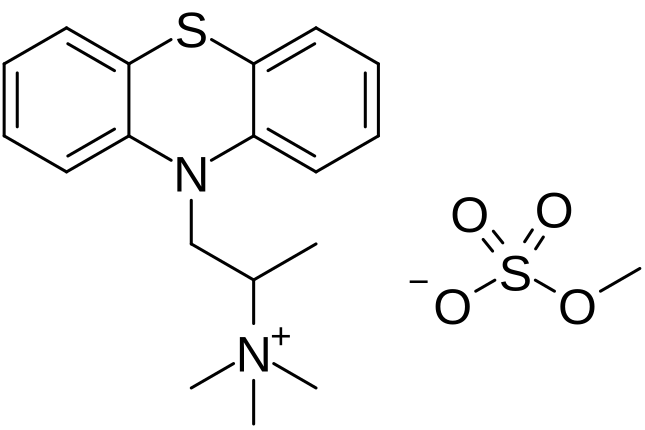
| IUPAC/Chemical Name | 4-N-(6-chloro-2-methoxyacridin-9-yl)-1-N,1-N-diethylpentane-1,4-diamine |
| InChl Key | GPKJTRJOBQGKQK-UHFFFAOYSA-N |
| InChl Code | InChI=1S/C23H30ClN3O/c1-5-27(6-2)13-7-8-16(3)25-23-19-11-9-17(24)14-22(19)26-21-12-10-18(28-4)15-20(21)23/h9-12,14-16H,5-8,13H2,1-4H3,(H,25,26) |
| References |
3D Conformer.
(Click, turn or enlarge)
Download our GMP API Product List.
MedicaPharma is an EU-based supplier of GMP-certified APIs that serves leading healthcare institutions and research organizations.
Click here to download our full API product list.