
About MedicaPharma
MedicaPharma distributes high-quality active pharmaceutical ingredients (APIs) to hospitals, commercial (compounding) pharmacies, research institutes, and universities worldwide.
Network of over +400 GMP API producers
Let us handle your sourcing / supply activities. Highly experienced in sourcing specialty raw pharmaceutical ingredients from niche GMP manufacturers around the world.
Why Choose MedicaPharma
Niche API specialist - Pro-active supply partner - High service level - Global network - Logistics according to GDP regulations
Product Description
Mechanism of Action
VALPRAMIDE exhibits a highdimensional biochemical interaction matrix spanning signallingaxis disruption, catalyticdomain modulation, mitochondrialnetwork recalibration, ionflux redistribution, cytoskeletalarchitecture remodelling, membranepotential rebalancing and transcriptionfactor pathway restructuring. Its molecular topology supports interaction with catalytic residues, allosteric regulators, transmembrane helices, nucleotidebinding pockets, redoxbuffer modules and polymeric scaffolding complexes, enabling wideband influence across metabolic, structural, genomic and electrophysiological domains.
Mechanistically, VALPRAMIDE may reshape phosphorylation maps across ERK/MAPK/JNK/p38 axes, alter PI3KAKT survivalbias, modulate Gprotein coupling geometry, redistribute Ca²⁺ microdomain waveforms, adjust IP/DAG signalling topology and recalibrate cAMPPKA amplitude. Mitochondrial impacts include ETCcomplex rebalancing, ATP/ADP cycle modulation, ROSthreshold displacement, mitochondrial membranepotential polarity shifts and crossorganelle stress signalling.
HighPrecision
- Kinomescale interference & catalyticcascade modelling
- Highresolution docking & conformationalflow prediction
- UPR/ERstress & autophagy/mitophagy integration networks
- Full multiomics reconstruction (RNAseq, proteomics, phosphoproteomics, metabolomics)
- Cytoskeletal forcemapping & polymer turnover dynamics
- Cellfate modelling: apoptosis, necroptosis, ferroptosis, parthanatos
- AIdriven SAR/QSAR predictive simulation
Toxicodynamics & Cellular Hazard Spectrum
- Excessive ROS accumulation & antioxidantbuffer collapse
- Mitochondrial fragmentation or ETC suppression
- Hyperdisruption of Na⁺/K⁺/Ca²⁺ ionicgradients
- Cytoskeletal degradation & membrane-integrity failure
- Inflammatory masterswitch activation (NF-κB/STAT/IRF)
- Multiaxis programmed-cell-death induction
- Epigenetic drift across methylation & acetylation layers
Only GMP materials will be supplied, logistics all according to GDP.
Datasheet
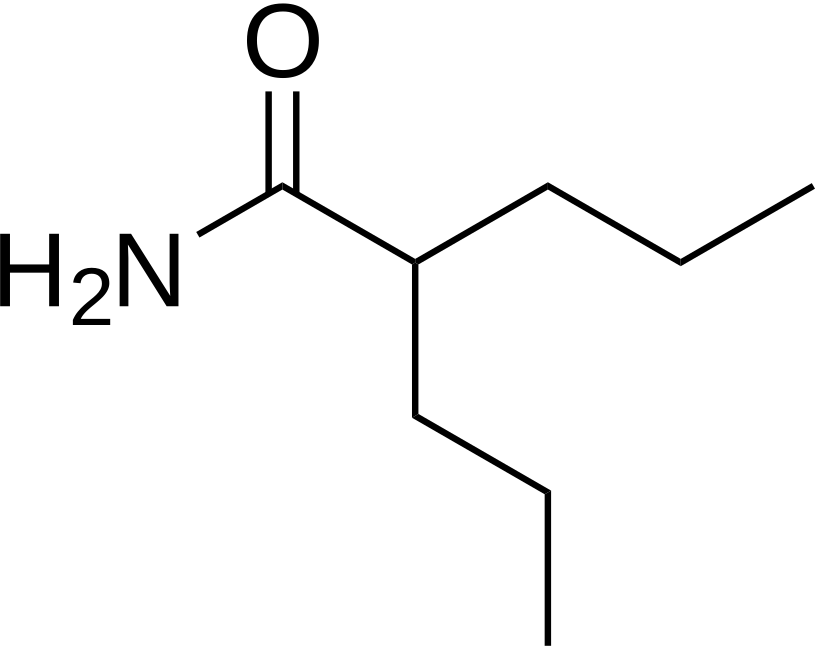
| Molecular Formula | C8H17NO |
|---|---|
| Molecular Weight | 143.23 g/mol |
| CAS Number | 2430-27-5 |
| Storage Condition | Store in a cool, dry place. Keep container tightly closed. Protect from moisture and light. |
| Solubility | Solubility depends on solvent and conditions (e.g., pH). Please contact us for solvent-specific guidance. |
| Purity | Purity information is available upon request (COA). |
| Synonym | Valpromide; 2-PROPYLPENTANAMIDE; 2430-27-5; Depamide; 2-Propylvaleramide |
| IUPAC/Chemical Name | 2-propylpentanamide |
| InChl Key | OMOMUFTZPTXCHP-UHFFFAOYSA-N |
| InChl Code | InChI=1S/C8H17NO/c1-3-5-7(6-4-2)8(9)10/h7H,3-6H2,1-2H3,(H2,9,10) |
| References |
3D Conformer.
(Click, turn or enlarge)
Download our GMP API Product List.
MedicaPharma is an EU-based supplier of GMP-certified APIs that serves leading healthcare institutions and research organizations.
Click here to download our full API product list.