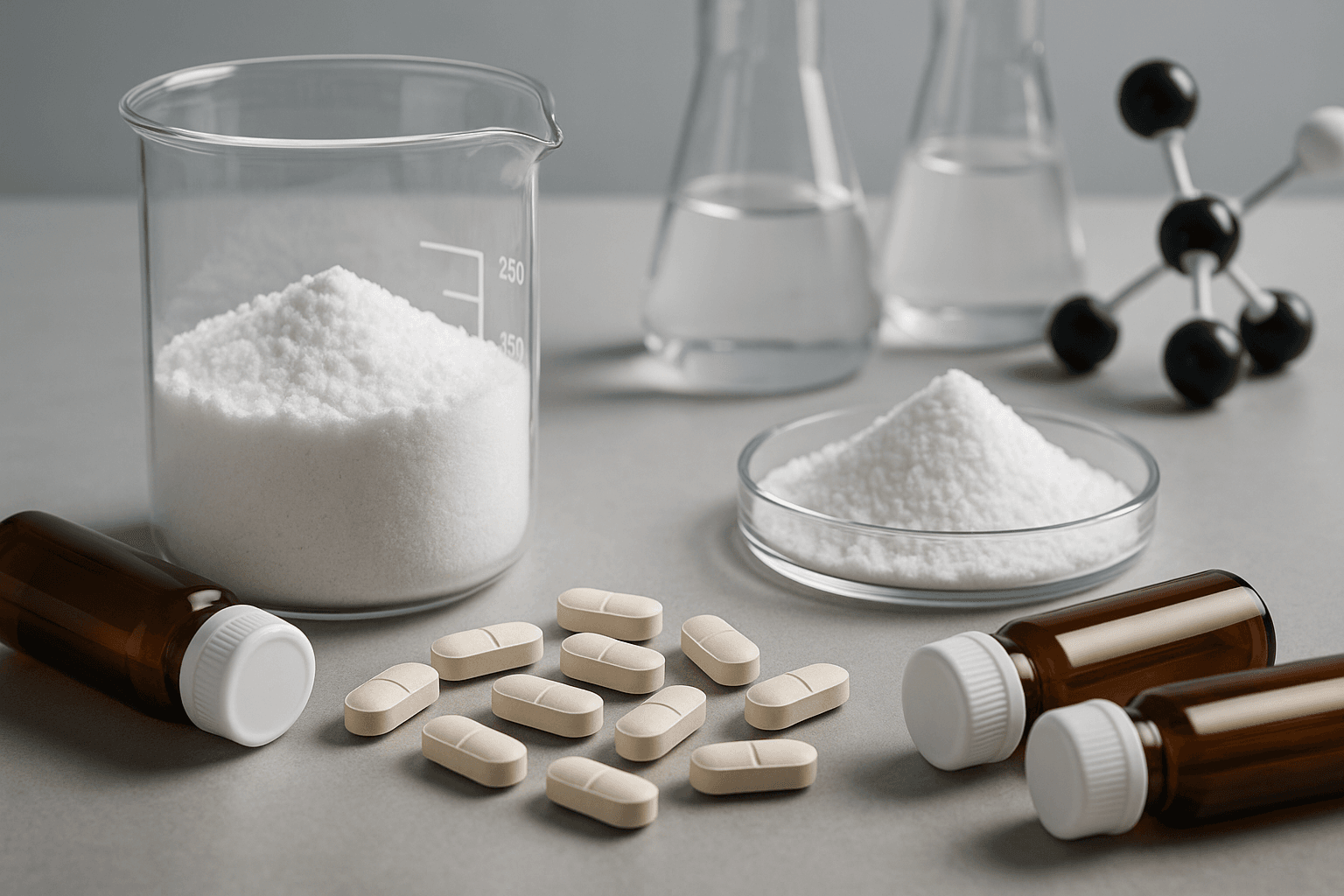
AMMONIUM BROMIDE


Ammonium Bromide is a research-grade compound used in advanced pharmaceutical and biochemical studies. Chemical & Pharmacological Characteristics The compound forms white crystalline solids and dissociates completely into NH 4 + and Br − in aqueous solution. Solution behavior is dominated by ionic strength, conductivity, and acid-base equilibria associated with ammonium hydrolysis. It exhibits limited intrinsic reactivity and provides reproducible preparation across a broad range of laboratory buffers, making it suitable for reference testing and controlled exposure paradigms. It is primarily applied to investigate compound-specific mechanisms,
About MedicaPharma
MedicaPharma distributes high-quality active pharmaceutical ingredients (APIs) to hospitals, commercial (compounding) pharmacies, research institutes, and universities worldwide.
Network of over +400 GMP API producers
Let us handle your sourcing / supply activities. Highly experienced in sourcing specialty raw pharmaceutical ingredients from niche GMP manufacturers around the world.
Why Choose MedicaPharma
Niche API specialist - Pro-active supply partner - High service level - Global network - Logistics according to GDP regulations
Product Description
Chemical & Pharmacological Characteristics
The compound forms white crystalline solids and dissociates completely into NH4+ and Br− in aqueous solution. Solution behavior is dominated by ionic strength, conductivity, and acid-base equilibria associated with ammonium hydrolysis. It exhibits limited intrinsic reactivity and provides reproducible preparation across a broad range of laboratory buffers, making it suitable for reference testing and controlled exposure paradigms.
Mechanism of Action
Ammonium bromide has no direct receptor target. Biological effects, when observed, arise from systemic ionic interactions and halide substitution phenomena. Bromide can partially substitute for chloride in certain transport contexts, which may influence membrane potential regulation and inhibitory signaling indirectly at elevated exposures.
The ammonium component can contribute to acid-base shifts depending on metabolic capacity and exposure conditions. In cell-based assays, apparent effects are often nonspecific and concentration-dependent, emphasizing the importance of osmolarity, pH, and buffer-matched controls when interpreting functional readouts.
Advanced Research Applications
- Halide ion reference for analytical assays and calibration standards
- Electrolyte and ionic strength modeling in formulation and stability studies
- Controlled bromide exposure paradigms for mechanistic physiology experiments
- Comparator material in salt-screening and counterion compatibility assessments
- Buffer preparation where bromide substitution is required for method development
Toxicodynamics & Cellular Hazard Spectrum
- Electrolyte imbalance at high exposure (bromide-chloride displacement effects)
- Neurological depression in sensitive biological models under supraphysiologic levels
- Ammonium-related acid-base perturbations depending on metabolic context
- Nonspecific cellular stress from osmotic shifts; requires matched controls
- Irritation risk from dust; standard chemical hygiene practices recommended
For expert laboratory research only – not intended for biological or therapeutic exposure.
Datasheet
| Molecular Formula | BrH4N |
|---|---|
| Molecular Weight | 97.94 g/mol |
| CAS Number | 12124-97-9 |
| Storage Condition | Keep well closed. |
| Solubility | In water, 78.3 g/100 g water at 25 °C |
| Purity | Purity information is available upon request (COA). |
| Synonym | AMMONIUM BROMIDE; 12124-97-9; Nervine; Ammonium bromatum; Ammonii bromidum |
| IUPAC/Chemical Name | azanium bromide |
| InChl Key | SWLVFNYSXGMGBS-UHFFFAOYSA-N |
| InChl Code | InChI=1S/BrH.H3N/h1H;1H3 |
| References | https://pubchem.ncbi.nlm.nih.gov/compound/25514; small-molecule |
3D Conformer.
(Click, turn or enlarge)
Download our GMP API Product List.
MedicaPharma is an EU-based supplier of GMP-certified APIs that serves leading healthcare institutions and research organizations.
Click here to download our full API product list.