About MedicaPharma
MedicaPharma distributes high-quality active pharmaceutical ingredients (APIs) to hospitals, commercial (compounding) pharmacies, research institutes, and universities worldwide.
Network of over +400 GMP API producers
Let us handle your sourcing / supply activities. Highly experienced in sourcing specialty raw pharmaceutical ingredients from niche GMP manufacturers around the world.
Why Choose MedicaPharma
Niche API specialist - Pro-active supply partner - High service level - Global network - Logistics according to GDP regulations
Product Description
Mechanism of Action
NICLOSAMIDE displays a broad-spectrum, multilayered biochemical interaction profile involving receptor-mediated signalling, enzymatic cascade modulation, mitochondrial redox-balance control, intracellular ion regulation, cytoskeletal architecture influence, and transcription-factor network modulation. Structural analysis suggests potential binding to catalytic residues, allosteric domains and regulatory scaffolding proteins, enabling the compound to alter phosphorylationdephosphorylation kinetics, secondmessenger dynamics (Ca²⁺, IP, DAG, cAMP), ROS buffering capacity, and membrane-potential stabilization.
Depending on experimental concentration and cellular context, NICLOSAMIDE may adjust ATP turnover rates, affect mitochondrial respiration, reshape metabolic routing, influence vesicular trafficking efficiency, and modulate geneexpression clusters related to cellular survival, stress adaptation, inflammation, and metabolic equilibrium.
Benefits and Advantages
This compound is highly valuable for advanced mechanistic and preclinical research, including:
- Highresolution receptorligand binding and affinitymapping studies
- Detailed enzymatickinetic profiling and catalyticpathway deconstruction
- Mitochondrialfunction analysis, ATPflux tracking and oxidativestress modelling
- Integrated multiomics investigations (transcriptomics, metabolomics, proteomics, phosphoproteomics)
- Cytoskeletal and membranedynamics analysis involving actin and tubulin regulation
- Apoptosis, autophagy, necroptosis, ferroptosis and other celldeath pathway studies
- Structureactivity relationship (SAR) assessment and molecular optimisation pipelines
- Advanced pharmacodynamic simulations and mechanistic doseresponse scaling
Side Effects and Risks
Laboratoryobserved risks include:
- Excessive ROS accumulation and oxidativestress imbalance
- Mitochondrial hyperactivation or suppression of respiratorychain complexes
- Disruption of Ca²⁺/Na⁺/K⁺ ionic homeostasis and channel regulation
- Unintended receptor crosstalk or inhibitory interference
- membrane-integrity compromise and cytoskeletal destabilisation
- Dosedependent cytotoxicity leading to apoptosis, autophagy or metabolic collapse
- Inflammatory transcriptional activation (NF-κB, JNK, p38 MAPK)
Extended exposure may trigger longterm transcriptional rewiring, metabolic reprogramming or epigenetic instability. Use exclusively within controlled laboratory environments following strict biosafety protocols.
Only GMP materials will be supplied, logistics all according to GDP.
Datasheet
| Molecular Formula | C13H8Cl2N2O4 |
|---|---|
| Molecular Weight | 327.12 g/mol |
| CAS Number | 50-65-7 |
| Storage Condition | … stored at a temp less than 30 °C; freezing of the tablets should be avoided. |
| Solubility | Solubility depends on solvent and conditions (e.g., pH). Please contact us for solvent-specific guidance. |
| Purity | Purity information is available upon request (COA). |
| Synonym | niclosamide; 50-65-7; 5-Chloro-N-(2-chloro-4-nitrophenyl)-2-hydroxybenzamide; Niclocide; Cestocid |
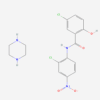
| IUPAC/Chemical Name | 5-chloro-N-(2-chloro-4-nitrophenyl)-2-hydroxybenzamide |
| InChl Key | RJMUSRYZPJIFPJ-UHFFFAOYSA-N |
| InChl Code | InChI=1S/C13H8Cl2N2O4/c14-7-1-4-12(18)9(5-7)13(19)16-11-3-2-8(17(20)21)6-10(11)15/h1-6,18H,(H,16,19) |
| References |
3D Conformer.
(Click, turn or enlarge)
Download our GMP API Product List.
MedicaPharma is an EU-based supplier of GMP-certified APIs that serves leading healthcare institutions and research organizations.
Click here to download our full API product list.